
Advertising Blind: He Spent Four Months Paying for Ads Nobody Was Measuring
Advertising blind
There's a conversation I've had so many times I could recite it from memory.
The business owner opens Ads Manager, points at a number, and says: "Look at this month — everything collapsed." I ask the obvious question: "Did the sales drop, or did the data drop?" And then comes the uncomfortable silence, because almost nobody knows the answer. Nobody checks that. We check ROAS, CPA, spend. Almost nobody stops to ask whether the number we're reading is real.
The case that stuck with me was a small shop. Modest budget, but steady — eight months of uninterrupted spend. At some point the developer made a change to the checkout. A perfectly reasonable improvement, by the way. And the purchase event stopped firing. Nothing else changed. The ads kept running. The budget kept coming off the card. And Meta kept optimizing — toward nothing.
Four months. Four months of paying for traffic the algorithm couldn't evaluate, because it never knew who bought and who didn't. When we finally caught it, the conversation wasn't technical. It was human. It was a man sitting across the table doing the mental math on what had walked out the door.
That's not a technology problem. That's misplaced trust.
Your pixel isn't what it used to be, and nobody told you
Let's get the uncomfortable part out of the way: browser-only tracking has been dying for years now.
This isn't a conspiracy theory. It's the sum of a lot of normal things. Safari restricts cookies. Firefox blocks trackers by default. Users install ad blockers without a second thought. Apple's privacy changes handed people a button that says "don't follow me," and people pressed it. Mobile networks drop mid-load. Tabs close before the script finishes running.
Each of those is an event that never arrived. Each event that never arrived is a sale that genuinely happened but that your report never saw.
The result is a business that's making money while its dashboard says otherwise. Or worse: a business that's losing money while the dashboard looks fine, because the handful of events that do get through are heavily skewed toward one very specific kind of user — the one who blocks nothing, has a solid connection, and browses on desktop Chrome. That person is almost never your average customer.
And here's the part most people don't connect. Meta's algorithm doesn't guess. It learns from what you send it. Feed it incomplete data and it doesn't learn less — it learns wrong. It goes out and finds more people who look like the few buyers it managed to see, and those few don't represent your actual customer base.
You're paying to train a model on bad information.
What the Conversions API actually is, in human terms
Forget the word "API" for two minutes.
The pixel is a messenger who lives inside your customer's browser. When someone buys, the messenger runs off to tell Meta. The problem is that this messenger has to cross hostile territory: blockers, blocked cookies, dropped connections, closed tabs. Sometimes he makes it. Sometimes he doesn't.
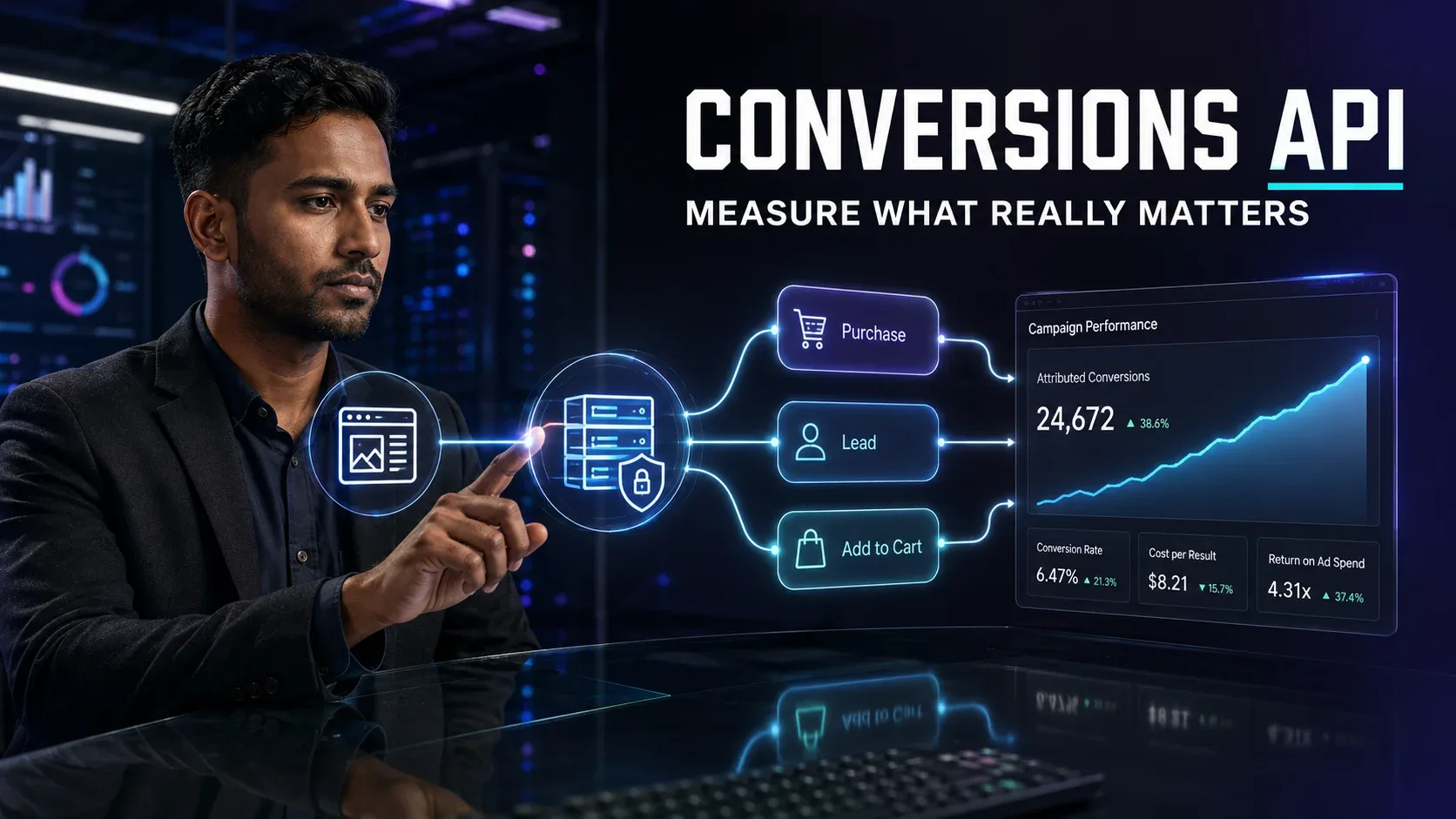
The Conversions API is a second messenger, but this one doesn't leave from the browser. It leaves from your server. And your server knows for a fact that the sale happened, because that's where the payment was processed. It doesn't depend on the customer's signal, or on which extensions they've installed, or on anything happening on their side of the screen.
One messenger that's fast but fragile. One that's slower but reliable. Both telling the same story.
That's the whole concept. Everything else is implementation.
"Won't my conversions get double-counted?"
This is objection number one, and I get it. If two messengers report the same sale, doesn't it get counted twice?
Not if you do it right. Meta handles this through something called deduplication, and the mechanic is straightforward: every event carries a unique identifier — the event_id — plus an event name. If the pixel and the server both send a Purchase with the same event_id, Meta understands it's one sale reported twice and records it once. In Events Manager you'll see it as "1 event from 2 sources," which is exactly what you want.
Two warnings that get expensive when ignored:
The event name has to match exactly. If the browser sends Purchase and the server sends purchase_web, Meta treats them as different things and you will get duplicates. This happens more often than it should.
Don't rely on timing. Two events arriving seconds apart without a shared event_id are still two separate conversions. Deduplication isn't temporal magic — it's identifier matching. And the window in which Meta will pair them is roughly 48 hours, so sending the server event three days later doesn't help either.
One piece of advice you'll thank yourself for later: make your event_id something that represents the business action, not a random string. The order number works beautifully. That way, when you eventually have to audit why an event didn't match, you can trace it back to a real sale in your database.
What changes when you finally measure properly
The numbers floating around the industry suggest recovering somewhere between 20% and 30% of the conversions the browser loses, with ROAS improvements in the 10-25% range over 30 to 60 days. Treat those as reference points, not promises — they depend enormously on your business type, your volume, and how broken your measurement was to begin with.
But the percentage isn't the point. What's happening underneath is.
When the algorithm receives complete, well-identified conversions, it stops optimizing blind. It finds buyers instead of finding clicks. It escapes the "I only see Chrome users who block nothing" bias. And you, on your side of the screen, stop making decisions based on fiction — which is where the real money leaks, far more than in your CPM.
There's one metric almost nobody watches that you should keep permanently within reach: Event Match Quality. It's a 1-to-10 score telling you how well Meta can match your events to real people. If you're sitting below 6, your measurement is running at half capacity even when the events are technically arriving. Aim for 7 or above, and the way to get there is sending more hashed user parameters — email and phone above all. Hashed. Always. Never in plain text.
Where to start without losing your mind
Not every business needs the same solution, and there are plenty of people charging good money for something the platform already gives you for free.
If you sell on Shopify, WooCommerce, or similar: use the native integration. It's an afternoon of setup, requires no code, and covers 90% of cases. Start here. Full stop.
If you have a custom build or need specific logic: server-side Google Tag Manager is the sensible middle ground. It costs a few dollars a month in hosting and does require someone who knows what they're doing, but it gives you real control.
If you're running at scale: direct API integration. Weeks of developer time, total control, and the ability to send offline events, CRM data, and call center conversions on the same rails.
And whatever you choose, two habits worth more than any sophisticated setup:
Check Events Manager once a week. It isn't glamorous, it takes five minutes, and it's the only thing standing between "I caught the problem on Tuesday" and "I caught the problem four months later."
Set an alert that pings you if purchase events drop to zero. Anything works — an automated email, a message, whatever. Setting it up costs you an hour. Not setting it up costs you what you read about at the top of this article.
The part nobody wants to hear
Measurement isn't the fun part of marketing. The fun part is the creative, the copy, the campaign that takes off. Measurement is plumbing.
But plumbing is what holds the house up. You can have the best creative on the market and still be burning cash, because the system deciding who sees it is learning from broken data.
And there's something underneath all this that's really why I wrote it. Every lost event isn't a data point. It's a person who wanted to buy from you, who filled a cart, entered their card, completed the purchase — and who, as far as your system is concerned, simply never existed. Multiply that by months and you're making decisions about your business based on an edited version of reality.
The Conversions API isn't an advanced technique or a big-agency luxury. At this point it's basic hygiene. If you're paying for ads and you don't have it configured, you're not doing digital marketing — you're gambling with extra steps.
Go check your Events Manager. Now. Before you read anything else.
Instalar en shopify https://apps.shopify.com/signalattribution?locale=en
What is https://signalattribution.com
Comments
Be the first to comment.